Summary
Living with a disability often means living with health needs that sit right alongside it.
Living with a disability often means living with health needs that sit right alongside it. A pressure injury that is slow to heal, a catheter that needs changing, a feeding tube that has to be managed every day. For many participants, the question is not whether they need nursing support, but whether the NDIS will pay for it and how to get it into their plan.
The answer depends on one important idea: the NDIS funds health supports that are linked to your disability, while the health system remains responsible for general medical care. Understanding that line makes it much easier to ask for the right supports, gather the right evidence and avoid gaps in your care. This guide explains what is covered, who can deliver it, and the practical steps to access it.
Community Nursing and the NDIS: The Basic Idea
Community nursing is clinical care delivered by a qualified nurse in your home or community, rather than in a hospital or clinic. Under the scheme, NDIS community nursing is not about treating illness in general. It is about managing health needs that exist because of your disability, so those needs do not stop you from living the life you want.
For example, a person with a spinal cord injury may need regular bowel care and skin checks. A person with a neurological condition may need help managing swallowing difficulties or a feeding tube. In each case, the health need is a direct result of the disability, and support with it helps the person stay safe and independent at home.
The NDIS describes these as supports that reduce the impact of your disability on daily life. They can include services from a nurse, training for the people who support you, and some equipment or consumables.
What the NDIS May Fund
The NDIA groups disability-related health supports into a set of areas. Not every participant will receive all of them, and funding always depends on your individual needs and evidence. The main areas include:
- Wound and pressure care. Funding may cover nursing support for slow-healing wounds and pressure injuries linked to your disability, along with dressings and pressure care equipment such as cushions. This matters most for people who spend long periods seated or in bed, where skin can break down quickly without regular checks.
- Continence and catheter care. A registered nurse may change an indwelling or suprapubic urinary catheter, assess continence needs and recommend suitable products. Consistent care here helps prevent infections that can lead to hospital admissions.
- Nutrition, dysphagia and enteral feeding. For people who have difficulty swallowing or who receive nutrition through a PEG or other feeding tube, the NDIS may fund assessments, feeding products and support with daily feeding. Some tasks can be delivered by trained support workers once a qualified practitioner has trained them.
- Respiratory care. This can include support for tracheostomy care, ventilation and cough assist equipment where breathing difficulties are related to your disability. These supports usually need close clinical oversight and well-trained workers on every shift.
- Diabetes management. Where your disability affects your ability to manage diabetes yourself, the NDIS may fund support with tasks such as blood glucose monitoring and insulin administration, along with training for your support team.
- Seizure monitoring and management. For participants with epilepsy related to their disability, supports may include seizure management planning and training for workers who need to respond safely.
- Training for workers and family. In many cases, the most practical support is a nurse training your regular workers or family members to carry out a task safely. The NDIA notes that family and friends must be trained by a qualified health professional and be competent before they take on clinical tasks.
Where the NDIS Stops and the Health System Starts
This is the area that causes the most confusion. The NDIS cannot fund services that are the responsibility of the health system. According to the NDIA, this includes hospital services, ambulance transport, medicines, palliative care, and the diagnosis and clinical treatment of health conditions, including ongoing and chronic conditions.
In practice, that means a nurse visiting after unrelated surgery, or care for an illness that is not linked to your disability, would generally be arranged through your GP, a hospital program or another health service. The same nurse might later provide disability-related support, such as catheter changes, that is funded through your plan.
Grey areas do come up. A wound might start from a hospital stay but become a long-term pressure risk because of reduced mobility. When this happens, clear notes from your treating health professional about how your disability affects the condition are what help the NDIA make a decision. Your GP should always be your first conversation about managing your overall health.
Who Delivers Nursing Supports in Your Plan
Nursing supports can be delivered by registered nurses (RNs) or enrolled nurses (ENs). Both must be registered with the Australian Health Practitioner Regulation Agency, and you can check any nurse’s registration on the Ahpra website.
Not every health-related task needs a nurse present each time. Good in-home nursing care often combines a nurse who assesses, plans and reviews care with trained support workers who carry out routine tasks day to day. This keeps clinical oversight in place while giving you consistent support across the week.
For the most complex supports, providers must meet extra rules. The NDIS Quality and Safeguards Commission sets out a high intensity daily personal activities module covering areas such as complex bowel care, enteral feeding, tracheostomy and ventilator management, urinary catheters, subcutaneous injections and complex wound care. Providers delivering these supports must be registered for them, train workers against set skills descriptors and arrange regular health reviews by a qualified practitioner. Asking a provider whether they are registered for the specific supports you need is a sensible first check.
How to Access Nursing Support Through Your Plan
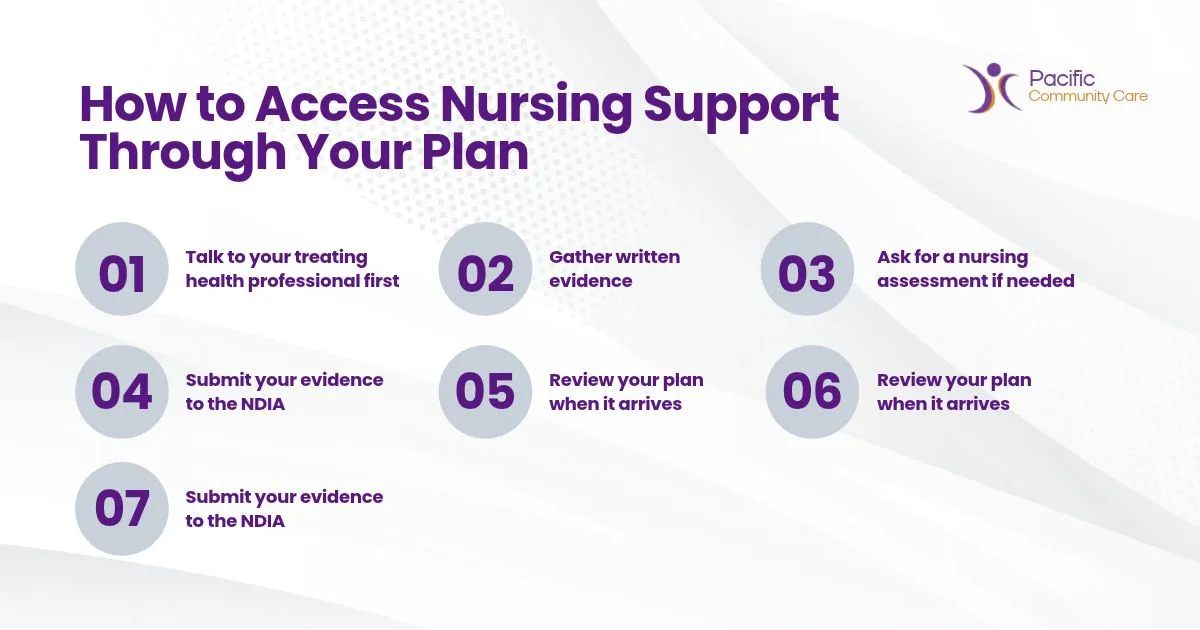
Getting the right community nursing services into your plan comes down to preparation and evidence. These steps will help:
1. Talk to your treating health professional first. Your GP, specialist or allied health team can explain which of your health needs are linked to your disability. Their input forms the foundation of any funding request, so book an appointment specifically to discuss this.
2. Gather written evidence. The NDIA looks for reports that describe your health needs, how they relate to your disability, what support is required and how often. Depending on the support, you may also need a nutrition, dysphagia or continence assessment, or a quote for equipment.
3. Ask for a nursing assessment if needed. A registered nurse can assess your needs at home and outline the clinical tasks involved, how often they occur and whether some can be safely delegated to trained workers. This detail helps the NDIA understand what is reasonable and necessary.
4. Submit your evidence to the NDIA. You can provide it through your NDIS partner, your my NDIS contact during a check-in or plan reassessment, or the NDIS service hub. A support coordinator can help you prepare and track this.
5. Review your plan when it arrives. Check that the funded supports match the needs in your evidence. If nursing support was not included, the NDIA must explain why, and you can request an internal review.
6. Choose a provider and agree on a care plan. Once funding is in place, your chosen provider should develop a care plan with you, your health team and your support workers, so everyone understands their role.
7. Request a plan change if things shift. Health needs can change after a hospital stay or as a condition progresses. If your needs increase, you can ask the NDIA to change your plan rather than waiting for a scheduled review.
If you are new to the scheme, our guide to how the NDIS works explains plans, partners and funding in plain language.
Getting the Most From Nursing Support
Once support begins, a few habits help it work well. Keep a simple health diary noting changes in skin, continence, swallowing or breathing, and share it with your nurse. Make sure your support workers know who to call if something looks wrong, and that emergency steps are written into your care plan.
Regular communication between your nurse, GP and support team is also key. When everyone is working from the same information, small issues are picked up early and hospital visits can often be avoided. If you have recently left hospital, short-term post-hospital discharge support can help bridge the gap while longer-term supports are set up.
Talking to Pacific Community Care About Your Plan
Pacific Community Care is a registered NDIS provider supporting participants across Tasmania, Victoria and Western Australia. Our community nursing team works alongside participants, families and treating professionals to deliver disability-related clinical care at home, and we also offer complex care for people with higher support needs.
If you are unsure whether your health needs could be funded, or you need help preparing evidence for your next plan, contact our team for a friendly, no-obligation conversation. Health professionals and coordinators can also refer a participant directly.
Disclaimer: This article provides general information only and does not constitute medical, legal or financial advice. NDIS funding decisions are made by the National Disability Insurance Agency based on individual circumstances and evidence. Please speak with your treating health professional, NDIS partner or support coordinator about your specific situation.