
Summary
For many people living with a serious mental health condition, independence isn't lost all at once.
For many people living with a serious mental health condition, independence isn’t lost all at once. It slips away in small pieces. Dishes pile up during a difficult week, a missed appointment becomes three, and the bus trip that used to be routine starts to feel impossible. The encouraging part is that those pieces can be rebuilt. With consistent, patient support focused on what the person wants, many people regain routines, skills and confidence they thought were gone for good.
At Pacific Community Care, we support NDIS participants living with psychosocial disability across Hobart and Melbourne. This guide explains how mental health support builds everyday independence, where it fits alongside clinical treatment, and how to tell whether the support you’re receiving is genuinely helping you grow.
What Independence Really Means
Independence is often misunderstood as doing everything alone. In practice, it means having choice and control over your own life: deciding when you get up, what you eat, who you see and how you spend your days, with whatever help you need to make those choices real.
For someone living with schizophrenia, bipolar disorder, severe depression or an anxiety disorder, the barriers are rarely physical. They are about energy, motivation, concentration, fear and unpredictable symptoms. A person may know exactly how to cook a meal but be unable to start on a bad day.
Good support works on those barriers directly. It doesn’t take over tasks; it helps a person do them, a little more each time, until the skill and confidence belong to them again.
Where NDIS Support Fits Alongside Treatment
The NDIS uses the term psychosocial disability to describe the functional impact a mental health condition can have on daily life. Not everyone with a mental health condition has a psychosocial disability. What matters is how the condition affects self-care, social connection, learning, and managing everyday tasks over the long term.
It is important to understand the division of roles. According to the NDIA’s guidance on psychosocial disability, the Scheme does not replace clinical treatment. Your GP, psychiatrist, psychologist and community mental health team remain responsible for diagnosis, medication and therapy. NDIS mental health support focuses on the practical side of recovery: daily living, routines, community participation and building capacity over time.
The two work best together. A psychiatrist may adjust medication to stabilise mood, while a support worker helps the person rebuild the morning routine the illness disrupted. That is why our workers coordinate with the participant’s treating team, with consent, rather than working in isolation.
The NDIA also recognises that many mental health conditions are episodic. A person can have long stable periods followed by harder months, and that pattern does not, on its own, rule out NDIS eligibility. Our guide to how the NDIS works explains the basics of access and planning.
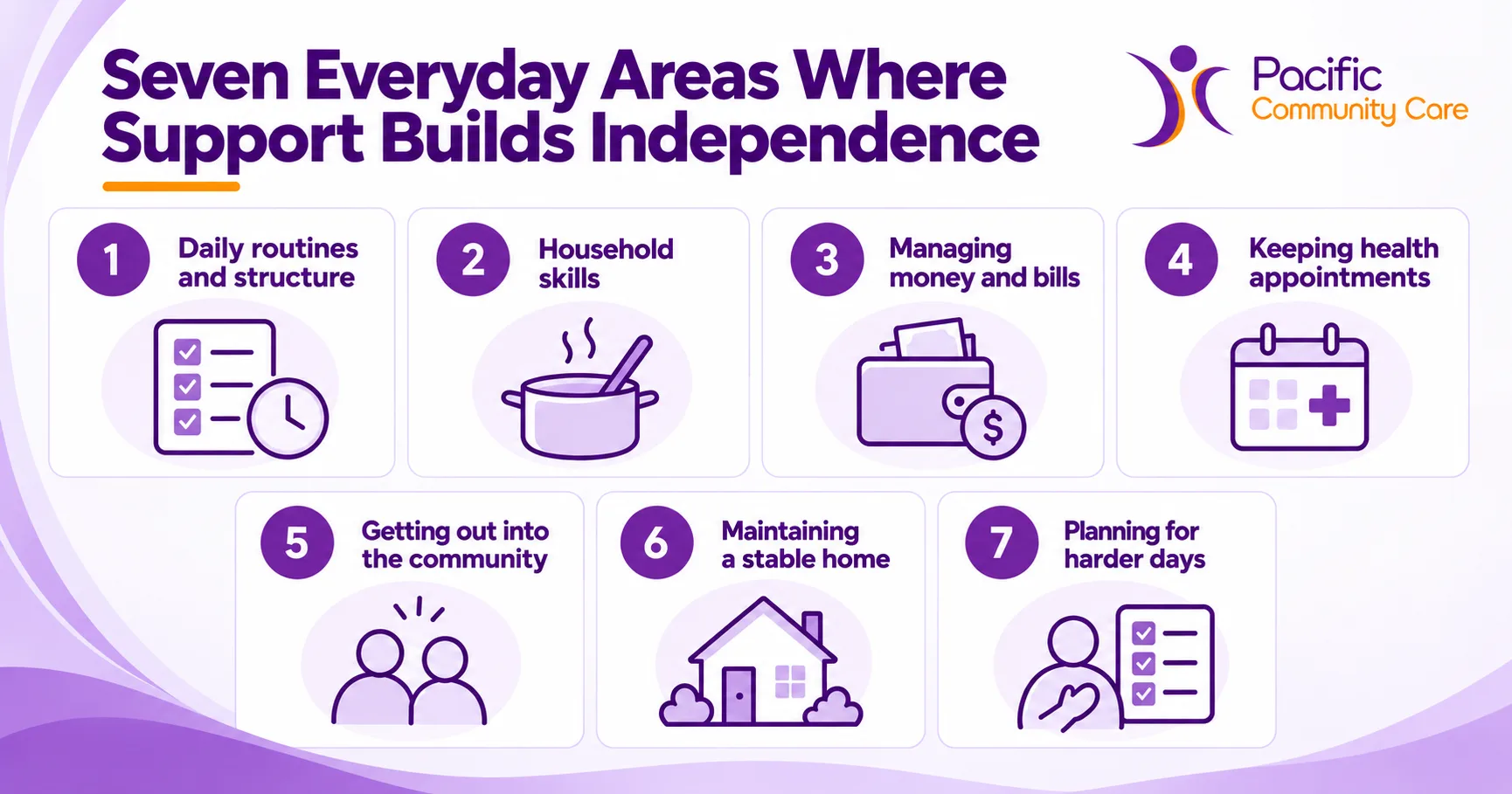
Seven Everyday Areas Where Support Builds Independence
Every plan is shaped around the participant’s own goals, so no two look the same. These are the areas where we most often see psychosocial disability support make a lasting practical difference.
1. Daily routines and structure.
Mental ill-health often disrupts sleep, meals and the basic rhythm of a day. A support worker can help a participant build a simple, realistic routine, such as getting up at a set time, having breakfast and planning one task for the morning. Structure reduces daily decisions and frees up energy for everything else.
2. Household skills.
Cooking, cleaning, laundry and shopping are the foundations of independent living. Support means doing these tasks with the person, not for them, in manageable steps. Over time, the worker steps back as the participant takes over, a process our in-home care team builds into every roster.
3. Managing money and bills
Budgeting is hard when concentration fluctuates or impulsive spending is part of a condition. Help to track expenses, set up direct debits and pay bills on time protects a tenancy and removes a major source of stress.
4. Keeping health appointments
Appointments with a GP, psychiatrist or community mental health team are central to recovery, yet often the first thing to slip. Support can include reminders, transport and, where wanted, company in the waiting room. Where medication is involved, workers prompt according to written instructions from the prescriber rather than making their own judgements.
5. Getting out into the community
Isolation and poor mental health tend to reinforce each other. Community access support might mean a worker who comes along to a first art class, a gym session or a volunteering shift, then gradually steps back as confidence grows. The goal is connection the participant can sustain on their own.
6. Maintaining a stable home
A secure home makes almost every other goal achievable. Support with tenancy obligations, upkeep and communicating with landlords helps prevent a crisis when a difficult period makes home life unmanageable.
7. Planning for harder days
Independence also means knowing what to do when things get tough. Working with the participant and their clinical team, support can include a plan that sets out early warning signs, what helps, and who to contact. That plan gives people a stronger sense of control, even when symptoms return.
Why Recovery Rarely Moves in a Straight Line
Progress in mental health is seldom smooth. A participant may make real gains over several months and then have a setback that seems to undo them. That is a normal part of recovery, not a sign of failure.
Good support adjusts to these shifts. A stable period might focus on new skills or returning to study; a harder patch may simply mean keeping essential routines in place so a difficult few weeks don’t become a crisis. If a participant does spend time in hospital, post-hospital discharge support can help re-establish routines from the first day home.
Consistency matters enormously. Trust takes time to build, and a constant rotation of new faces can undermine progress, which is why we match participants with workers on approach and personality, not just availability.
It also helps to use funding purposefully, as NDIS budgets for community participation and daily living skills are being reduced for many participants at plan reassessment. Linking each support to a clear goal, and recording what it achieves, makes the most of your funding and builds evidence for your next plan. A support coordinator can help you see which budget each support draws from.
Six Signs Your Support Is Building Independence
Some support arrangements quietly create dependence, with workers doing tasks out of habit rather than helping the person learn. These signs suggest yours is moving in the right direction.
- Your goals are written in your own words. Your support plan should reflect what you want, such as cooking dinner twice a week or catching the bus to TAFE, not a generic list of services. Goals in your own language keep everyone focused on what matters to you.
- Your worker does less over time. Early on, a worker may do much of a task alongside you. Over the months, they should step back, prompting rather than doing, and eventually just checking in.
- Progress is tracked and reviewed with you. Regular reviews of what is and isn’t working help everyone adjust, and progress notes become valuable evidence at reassessment.
- Your treating team is in the loop. With your consent, your provider should share relevant updates with your GP or psychiatrist and build their advice into daily support. If your support worker and clinicians never communicate, something important is missing.
- You have access to recovery-focused expertise. A psychosocial recovery coach is an NDIS-funded role that helps participants build capacity, plan their supports and connect with mental health services outside the Scheme, as the NDIA’s recovery coach guidance explains. Whether or not your plan includes a coach, the support you receive should be grounded in recovery principles rather than simply filling hours.
- Your feedback is welcomed and acted on. You should know who to speak to if something isn’t working, and see changes when you raise a concern. Registered providers must have a complaints process, and good ones actively ask how things are going.
When You Need Help Quickly
NDIS supports are not crisis services. If someone is in immediate danger, call Triple Zero (000). Lifeline is available 24 hours a day on 13 11 14. In Tasmania, Access Mental Health on 1800 332 388 offers round-the-clock phone support, triage and referral to public mental health services. Keep these numbers somewhere easy to find.
How Pacific Community Care Supports Mental Health and Independence
Pacific Community Care is a registered NDIS provider delivering person-centred supports aligned with the NDIS Practice Standards and NDIS Code of Conduct. Our mental health care is trauma-informed and recovery-focused, and every mental health support worker completes specific training before working with participants living with psychosocial disability.
We support people living with schizophrenia, bipolar disorder, anxiety, depression and other psychosocial disabilities through daily living support, life skills, community participation, tenancy support and collaborative safety planning. Our team includes support workers, registered nurses, support coordinators and allied health professionals, with after-hours and weekend on-call assistance.